

Posted by Kelvin Brake & Rebuild Ltd on 4th Feb 2026
Air Compressor Identification & Cross-Reference Guide
Air Compressor Identification and Interchange Guide
When your truck's air compressor fails on a Friday afternoon and you need it back on the road by Monday morning, accurate identification isn't just helpful, it's essential. Since 1985, Fleet Products has been helping fleet managers and technicians across North America solve exactly these kinds of problems. This comprehensive guide will help you identify your compressor quickly, understand which models are interchangeable, and get the right replacement part the first time.
Why Accurate Compressor Identification Saves Time and Money
A misidentified compressor means ordering the wrong part, waiting for returns, losing revenue while your truck sits idle, and potentially damaging your air system with an incompatible replacement. The difference between a Tu-Flo 500 (12 CFM) and a Tu-Flo 750 (16.5 CFM) affects your entire air brake system's performance.
At Fleet Products we see this challenge daily. Proper identification using our cross-reference system ensures you get OEM-quality remanufactured or new parts that fit right and work flawlessly.
Finding Your Compressor Identification Tag
The fastest path to accurate identification starts with locating your compressor's tag. Most compressors display this critical information on a metal tag attached to the crankcase side or cylinder head. The tag typically shows three vital pieces of information:
Remanufactured Part Number
Industry-standard aftermarket numbers used by quality rebuilders like Fleet Products' KBR. These numbers have become the universal language of the replacement parts market.
Original Equipment (OE) Number
The manufacturer's designation for compressors built for specific vehicle brands. For example, a Bendix compressor made for Freightliner carries a different OE number than the same compressor made for Kenworth.
Vehicle/Engine Manufacturer Number
Sometimes the tag displays the truck or engine maker's part number rather than the compressor manufacturer's. These numbers require cross-referencing to identify the actual compressor model.
Compressor Identification Flowchart
Understanding Compressor Families and Interchangeability
Bendix Tu-Flo Series:
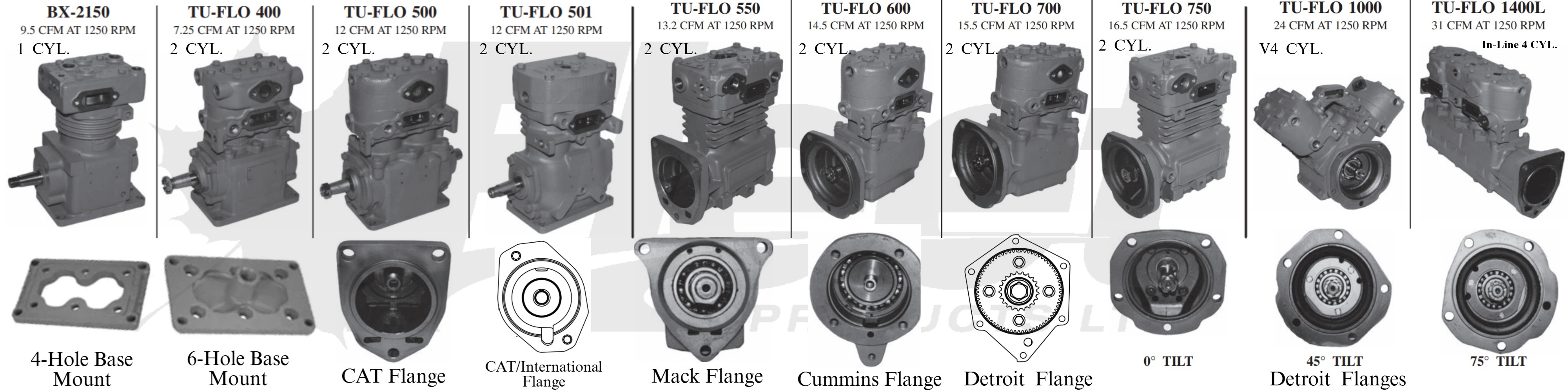
Bendix Tu-Flo compressors dominate North American heavy-duty applications, and understanding their interchangeability can save significant money and downtime. Part Numbers usually begin 101, 106, 227, 228, 229, 275, 276, 277, 279, 280, 283, 285, 289.
Tu-Flo 300 (4 CFM @ 1250 RPM)
- Belt-driven only
- Air-cooled design
- Available in engine-lube and self-lube configurations
- Separate head, block, and crankcase construction
- Common in medium-duty trucks and older equipment
Tu-Flo 400 (7.25 CFM @ 1250 RPM)
- Multiple cooling options: air, water, or combo
- Available in pulley-driven (vertical, side, offset mount) and direct-drive flange mount
- Two-cylinder reciprocating design
- Widespread use across Class 6-8 trucks
Tu-Flo 500 and 501 (Both 12 CFM @ 1250 RPM)
These models deserve special attention because of their interchangeability:
- Tu-Flo 500: Traditional separate head, block, and crankcase
- Tu-Flo 501: Integral block and crankcase (one-piece design)
- Both offer identical displacement and mounting options
- Choice between them often depends on parts availability and price
Tu-Flo 550 and 750: Direct Interchange Superstars
Here's where understanding interchangeability really pays off:
- Tu-Flo 550: 13.2 CFM @ 1250 RPM
- Tu-Flo 750: 16.5 CFM @ 1250 RPM
- Critical fact: These compressors are cosmetically identical and bolt-in interchangeable
- The 750 achieves higher output through a longer piston stroke (different wrist pin location)
- Same crankcase, same mounting pattern, same external dimensions
Why this matters: If you need a 550 but your supplier only has a 750 in stock (or vice versa), you can interchange them. The 750 simply provides more air capacity, beneficial for vehicles with extensive pneumatic accessories or frequent trailer swaps. Many fleet managers intentionally upgrade to 750s during replacement to future-proof their air systems.
Tu-Flo 600 (14.5 CFM @ 1250 RPM)
- Multiple cooling configurations
- Vertical mount or direct drive
- Popular in heavy-haul and vocational applications
Tu-Flo 700 (15.5 CFM @ 1250 RPM)
- Full water cooling (head and block)
- Multiple mounting options
- Excellent for high-duty-cycle applications
Tu-Flo 1000 (24 CFM @ 1250 RPM)
- Four-cylinder powerhouse
- Air or water-cooled options
- Used in heavy-duty trucks with extensive air demands
Tu-Flo 1400L (31 CFM @ 1250 RPM)
- Purpose-built for Mack in-line 6, Caterpillar, and Detroit Diesel
- Four-cylinder design
- Direct drive flange mount only
BA921 and BA922: Modern Technology
- BA921: Single-cylinder, 15.8 CFM @ 1250 RPM
- BA922: Two-cylinder, 31.6 CFM @ 1250 RPM
- Water-cooled heads with integral air-cooled crankcases
- Newer technology with improved efficiency and reduced noise
Know Your Numbers: Compressor Output Range
Midland Compressors:
Midland makes identification easy, the model number often indicates displacement capacity.
| Specification | EL740 (Pulley Drive) | EL850 | EL1300 | EL1600 | EL3200 |
|---|---|---|---|---|---|
| Bore (inches diameter) | 2.75 | 3.15 | 2.75 | 2.75 | 2.75 |
| Stroke (inches) | 1.5 | 1.5 | 1.5 | 1.87 | 1.87 |
| Turbo-Charge Pressure (Max PSI) | 35 | 25 | 35 | 35 | 35 |
| Rated Displacement @ 1250 RPM (CFM) | 7.4 | 8.5 | 12.9 | 16.1 | 32.2 |
| Number of Cylinders | 2 | 1 | 2 | 2 | 4 |
EL740 (7.4 CFM @ 1250 RPM)
- Air or water-cooled head options
- Pulley or direct drive
- Two-cylinder design
EL850 (8.5 CFM @ 1250 RPM)
- Single-cylinder configuration
- Available in air and water-cooled versions
- Compact footprint for tight engine compartments
EL1300 and EL1600: The Tab Tells the Tale
- EL1300: 12.9 CFM, NO tab on block
- EL1600: 16.1 CFM, DISTINCTIVE TAB on block
- Both water-cooled only
- Identical external appearance except for that identifying tab
- Common in Caterpillar and Cummins applications
EL3200 (32.2 CFM @ 1250 RPM)
- Four-cylinder heavy-duty unit
- Water-cooled design
- Direct drive single flange mount
- Engineered for Mack and Detroit Diesel applications
Holset/Cummins Compressors:
Holset compressors are standard on many Cummins engines and feature gear drive systems for reliability. Suffixes like D, M, and C identify the engine platform—Detroit Diesel, Mack, and Cummins—and when followed by E, they indicate an E-Type unloader configuration for that engine series. Meanwhile, prefixes such as SS (Super Single), ST (Super Twin), and QT (Quiet Economy) define the compressor family before the model number. ALL QE MODEL COMPRESSORS REQUIRE A 4 LINE DRYER 065647WL-G EXTRA LINE BY ITSELF like 500457.
| Model Number | Description | CFM |
|---|---|---|
| SS191 | Single Cylinder (Midland EL-850 equivalent) | 8.5 CFM |
| QE296 | Single Cylinder | 9.8 CFM |
| QE296/SS296 | Single Cylinder (High output variant) | 13.2 CFM |
| QE338/SS338 | Single Cylinder | 15 CFM |
| ST676 | Twin Cylinder | 30 CFM |
| ST773 | Twin Cylinder | 34 CFM |
SS191 (8.5 CFM @ 1250 RPM)
- Water and air-cooled versions available
- Gear-driven only
- Optional accessory drive capability
- Note: Shares visual characteristics with Midland EL850
SS296 (13.2 CFM @ 1250 RPM) and SS338 (15.0 CFM @ 1250 RPM)
- Water-cooled single-cylinder design
- Gear-driven with optional accessory drives
- Common in over-the-road applications
QE Series: Quieter Operation
- QE296: 13.2 CFM (matches SS296 output)
- QE338: 15.0 CFM (matches SS338 output)
- All-cast-iron heads reduce noise and improve efficiency
- Direct replacement for corresponding SS models
HD Series: Continuous Duty Champions
- HD650: 13.2 CFM
- HD850: 15.0 CFM
- Specifically engineered for non-stop pumping applications
- Ideal for vocational trucks with constant air system demands
ST676 and ST773: Twin-Cylinder Power
- ST676: 30.0 CFM @ 1250 RPM
- ST773: 34.0 CFM @ 1250 RPM
- Water-cooled two-cylinder design
- Gear-driven configuration
- Used in heavy-duty on-highway and severe-service applications
Wabco Compressors:
Wabco compressors appear across diverse vehicle platforms, particularly in European-designed trucks and engines. Part numbers usually begin with 911, 912, 411, 412. Comes with 75mm or 85mm pistons and single- and twin-cylinder configurations. These compressors come without rod bearings.
Every Wabco part has a 10 digit Part Number ("S" in front indicates New Condition), Identify it by e.g. 911 154 (Product Type) 500 (Version) 0 (Condition= "0" New, "2" Repair kit/Sub Part, "4" Individual Part, "7 / R" Reman (Have Red Plate))
Single-Cylinder and Two-Cylinder Models
- 15.2 CFM or 18.7 CFM @ 1250 RPM
- Water-cooled only
- Various engine-specific flange configurations
- Fleet Products maintains extensive Wabco inventory.
Mounting Configurations: Matching Your Application
Understanding mounting types prevents ordering errors:
Belt-Driven Vertical Mount
- Most common configuration
- Base mounting patterns: 4-hole, 6-hole, or no-hole designs
- Requires proper pulley alignment and belt tension
Direct Drive Flange Mount
- Bolts directly to engine accessory drive
- Engine-manufacturer-specific flange patterns
- Eliminates belt maintenance
- Available in single and double flange designs
Side Mount and Offset Mount
- Space-saving configurations
- Used when clearance is limited
- Common in medium-duty and cab-over designs
Gear-Driven Systems
- Standard on Holset/Cummins compressors
- Extremely reliable power transfer
- Optional accessory drives for power steering pumps
Cooling System Considerations
Your compressor's cooling method affects installation and performance:
Air-Cooled
- Simplest installation (no coolant connections)
- Best for moderate-duty cycles
- Requires adequate air flow around compressor
- Lower initial cost
Water-Cooled
- Superior temperature control during heavy use
- Connects to engine cooling system
- Essential for vocational and severe-duty applications
- Fleet Products recommends water-cooling for dump trucks, refuse haulers, and concrete mixers
Combination Cooling
- Water-cooled head, air-cooled block
- Balances cooling effectiveness with installation simplicity
- Popular compromise for varied duty cycles
Practical Field Identification Steps
When you're in the shop facing an unmarked compressor:
Cross-Reference Success Stories
Fleet Products' cross-reference database contains thousands of part numbers from OE manufacturers, aftermarket suppliers, and remanufactured units. Here's how it works in practice:
Compressor Displacement: Matching to Your Air Demand
Understanding your vehicle's air consumption helps select appropriate replacements:
Maintenance and Longevity Tips
Proper identification leads to correct replacement, but smart maintenance extends compressor life:
The Bottom Line: Knowledge Prevents Downtime
Compressor identification isn't just about finding a part number, it's about understanding your air system's capabilities, knowing your options, and making informed decisions that keep your fleet profitable.
A Tu-Flo 500 might meet minimum requirements, but a Tu-Flo 750 could provide the reserve capacity that prevents failures during peak season. An EL1300 works fine until you look at the upcharge for an EL1600 and realize 16.1 CFM vs. 12.9 CFM could eliminate those long air buildup times at the truck wash.
Fleet Products has spent nearly 40 years building the knowledge base and relationships that solve these problems daily. Whether you're a one-truck owner-operator or managing a 500-vehicle fleet, we provide the parts, expertise, and support that keep your trucks moving.
When your compressor tag is illegible, your usual supplier is out of stock, or you're facing an emergency, remember that Fleet Products' team has seen it before and solved it. We're not just parts suppliers, we're your partners in uptime.
Shop Fleet Products for Complete Air System Solutions
Since 1985, Fleet Products and our KBR Rebuilders have been North America's go-to source for air compressor expertise. Here's what sets us apart:
Extensive Inventory
- New OEM & Aftermarket compressors from Bendix, Wabco, Midland, Holset
- Certified remanufactured units from KBR Rebuilders
- Same-day shipping from Calgary, Vancouver, or Toronto warehouses
Quality Remanufacturing
At KBR, we don't just rebuild compressors, we remanufacture them to OEM standards:
- Complete disassembly and inspection
- Precision machining of wear surfaces
- New pistons, rings, valves, and seals
- Testing to original specifications
- Industry-leading warranty coverage
- Experienced technical support team
Beyond the Common Manufacturers
While Bendix, Midland, Holset, and Wabco dominate North American markets, Fleet Products also stocks and services for compressors from:
Air System Components
Brake Components
Expert Support
Contact Fleet Products
Locations: Calgary | Vancouver | Toronto
Serving North America's fleets since 1985 with quality parts, expert knowledge, and unmatched service.